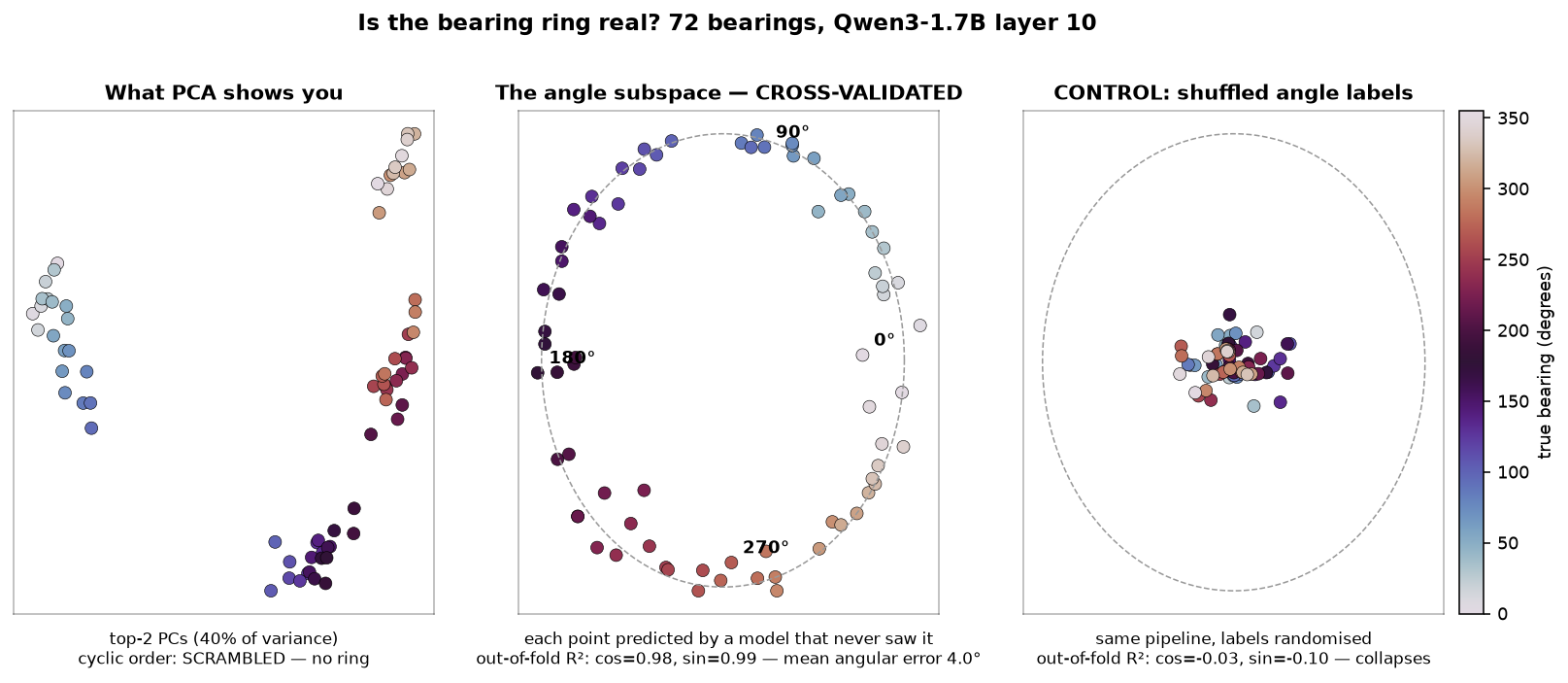
We opened up a small AI model to find out whether it stores ideas as shapes. It does — there is a near-perfect circle in there. Then we discovered it barely uses it.
There is a fight going on in AI interpretability, and it comes down to a simple question: what shape are the model's ideas?
When an AI reads a word, it turns that word into a long list of numbers — about 2,000 of them. That list is the model's "thought" at that instant. Everything the model knows about the word is in those numbers somewhere.
The question is how ideas are arranged in that space of numbers. Two camps:
Each concept is a direction. Want the model to be more polite? Find the "politeness direction" and push its numbers that way. This is how most AI steering works today, and it's the idea behind the popular tool called a sparse autoencoder (SAE), which tries to break a thought into a list of simple ingredients.
Concepts live on curved shapes — loops, ribbons, spirals. If that's true, pushing in a straight line shoves the model off the shape into nonsense. You should instead slide along the curve. Camp B also says SAEs "shatter" these shapes — smashing a smooth loop into unrelated fragments.
Camp B has a great demo: a tiny model that drives a car up a hill. Slide along the curve and the car moves smoothly; cut a straight line across and the car teleports and glitches. Convincing.
But that's a toy car model, not a language model. Nobody had run the equivalent test inside an actual LLM. So we did.
To test "curved shapes", you need an idea that is genuinely a circle. Our choice was compass bearings.
A bearing is just a compass direction written as a number of degrees.
0° = north. 90° = east. 180° = south. 270° = west.
And then 355° is right back next to 0° — because a compass is a circle.
That last part is the whole point. Bearings are:
Continuous — 137° is a real direction, and so is 138°. You can go as
fine-grained as you like.
Circular — go far enough and you come back to where you started.
We tried days first. It was a mistake, and it's worth explaining why.
Days of the week are a circle (Sunday loops back to Monday). But they are not continuous. There is no "Tuesday-and-a-half." So you can't ask the interesting question — "what does the model think lives between two ideas?" — because with days, there's nothing in between. Bearings fix that: 45° sits happily between 40° and 50°.
So we fed the model 72 sentences — "A bearing of 000 degrees…",
"…005 degrees…", all the way round to 355 — and wrote down the ~2,000
numbers it produced each time.
Now we have 72 lists of 2,000 numbers. Is there a circle hiding in there?
The standard way to look is a tool called PCA. Think of it as: "show me the biggest patterns in this data." It's what almost everyone reaches for first.
PCA showed us garbage. A scrambled mess with no circle at all.
But we didn't stop there — and here's the surprise. We went looking for a circle specifically, instead of asking for "the biggest patterns," and a perfect one fell out.
Here's the thing that makes this genuinely useful. The model is reading the text
"A bearing of 137 degrees". Most of what's in its head is not the direction —
it's the digits on the page: "1", "3", "7". Which characters am I looking at?
That spelling information is huge. The actual compass direction is a faint whisper underneath it — just 9.6% of the signal.
PCA asks "what's the biggest pattern here?" and the answer is "the spelling". So PCA hands you the spelling and hides the compass.
If you go hunting for these curved shapes using PCA or UMAP — the two tools everybody uses — you will miss them. They're buried under how the words are spelled. You have to know what you're looking for in order to find it.
Finding a circle is not the same as showing the model thinks with it. A shadow on the wall is a real shape, but the shadow isn't doing anything.
So we did surgery. We reached into the model's head and edited only the circle part, leaving everything else untouched — the equivalent of spinning the compass needle from north to east while leaving the rest of its brain alone. Then we asked the model which way it thought it was pointing.
We spun the needle to east. The model kept saying north.
It wasn't listening to the beautiful circle. It was reading the digits on the page.
Then we pushed harder. And harder. Turn the dial up about six times past its natural strength, and the model finally starts to listen.
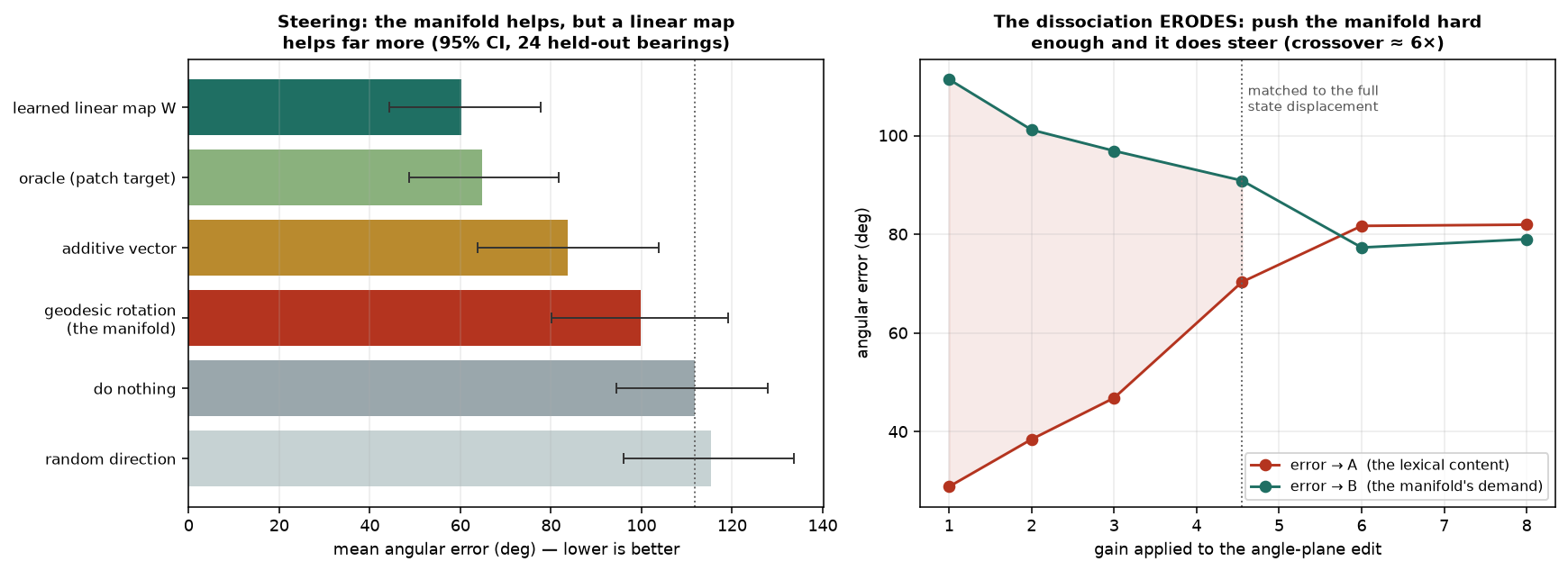
We ran a contest. One job: "turn every bearing 90° clockwise." Four contestants:
| method | how wrong it was | |
|---|---|---|
| A plain learned matrix (boring maths) | 60° | winner |
| The theoretical best possible | 65° | the ceiling |
| A simple "push in a direction" nudge | 84° | |
| Sliding along the circle (the fancy geometry) | 100° | loses |
| Doing nothing at all | 112° | the floor |
Sliding along the circle does beat doing nothing — that's a real effect, and it confirms the circle isn't a total illusion. But a plain, boring matrix beats it by a mile, and ties with the theoretical best possible score.
The elegant geometry is real. It is just not where the work happens.
Camp B says "linear steering fails on circles, so you need curved geometry."
But here's the thing: a rotation is itself a piece of plain linear maths. Spinning a compass needle is not some exotic curved operation — it's a matrix, the kind of thing taught in a first-year algebra class.
So the real distinction was never "straight vs. curved". It's:
❌ Adding a fixed nudge to every thought — can't rotate a circle. (If you add the same push everywhere on a ring, you shove some points forwards and others backwards.)
✅ Applying a matrix — can rotate a circle, easily.
Both are "linear". You don't need fancy curved-space mathematics to steer a circle. You just need a matrix instead of a vector.
Camp B's other accusation: sparse autoencoders (the popular interpretability tool) smash these smooth shapes into unrelated fragments.
We tested it the hard way. We took a thought about Thursday, ran it through the SAE and back out, then planted the result into a sentence about Monday. If the SAE preserved what "Thursday" really is, the model should now say Thursday. If the SAE destroyed it, the model should shrug and say Monday.

We tested lots of circular ideas, not just bearings. Something odd showed up.
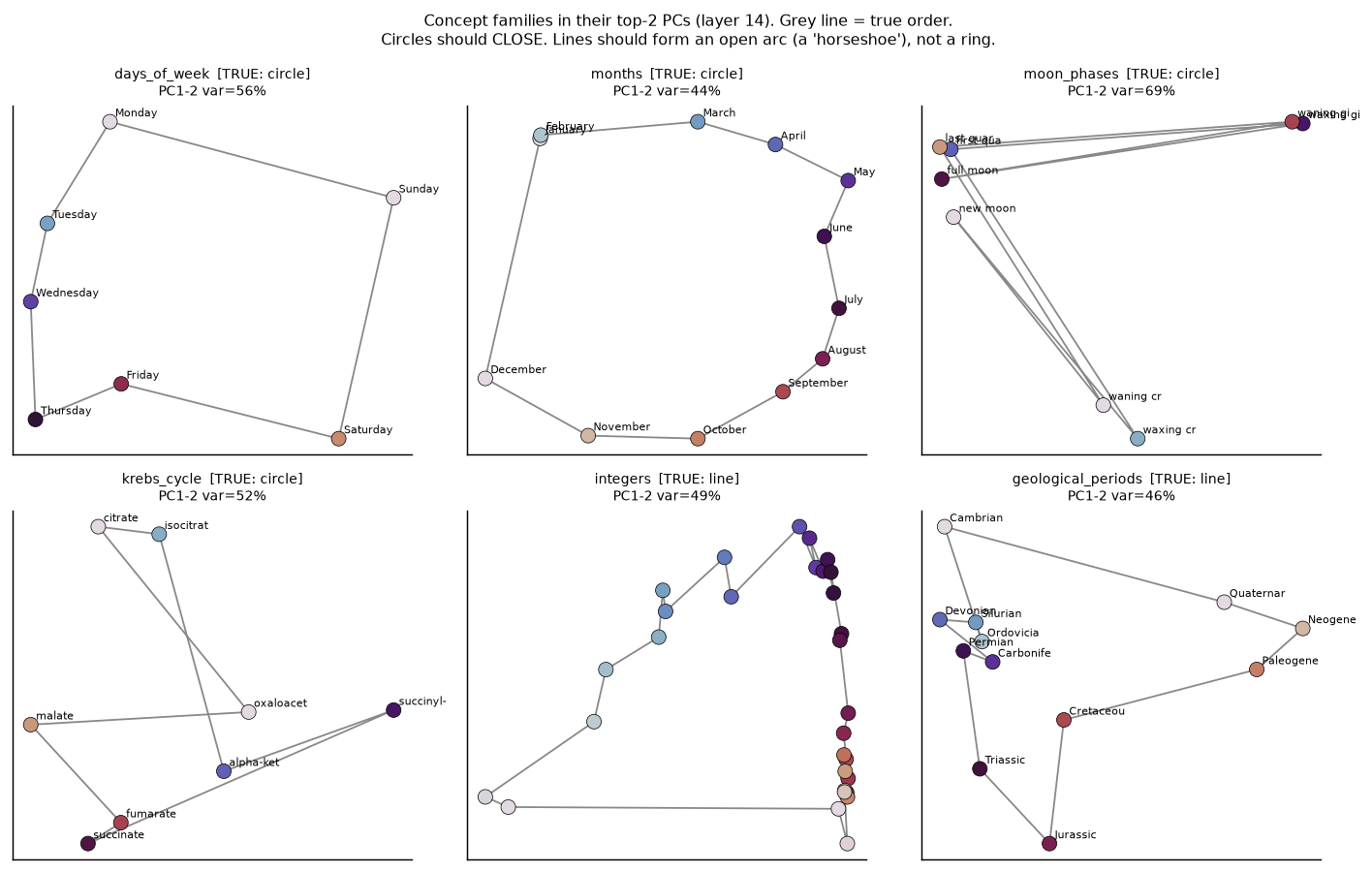
The moon really does cycle. The Krebs cycle really does close — oxaloacetate turns back into citrate, it's a loop, that's why it's called a cycle. But the model doesn't store them as circles.
The model builds a circle when text keeps listing the thing in a loop ("Monday, Tuesday, Wednesday…" appears endlessly). It does not build one just because the thing is genuinely circular in reality.
The model's geometry mirrors its reading material, not the world. That's a weaker — and far more interesting — claim than "neural networks discover the structure of reality."
We ran an adversarial reviewer against our own work at the end, whose only job was to try to destroy it. It found a lot. Six of our claims had to be retracted. Here are the three worst mistakes, because they're more instructive than the results.
A one-character indexing slip meant we were reading the model's thoughts about the word
before each concept. Every "month" we analysed was actually the word is. All
twelve months came out identical. The software cheerfully produced a full page of
beautiful statistics about absolutely nothing.
The most dangerous one. When we told the model's compass to turn right, our code turned it left. So "sliding along the circle" was steering in reverse, and scored worse than doing nothing at all.
We nearly published that as a dramatic headline: "curved-geometry steering actively harms the model!" It was a bug. Fixed, the honest answer is far more boring: the circle helps a little.
A bug that makes your results more exciting is the one you're least motivated to look for. Two of our three bugs made our findings look better than they were.
Our first "proof" of the circle was drawn using a method that had already been shown the answers. In that situation the method will draw you a beautiful circle even from pure random noise. Worse, the caption on our own chart said "ring holds" — hardcoded — while the test underneath it was quietly returning false.
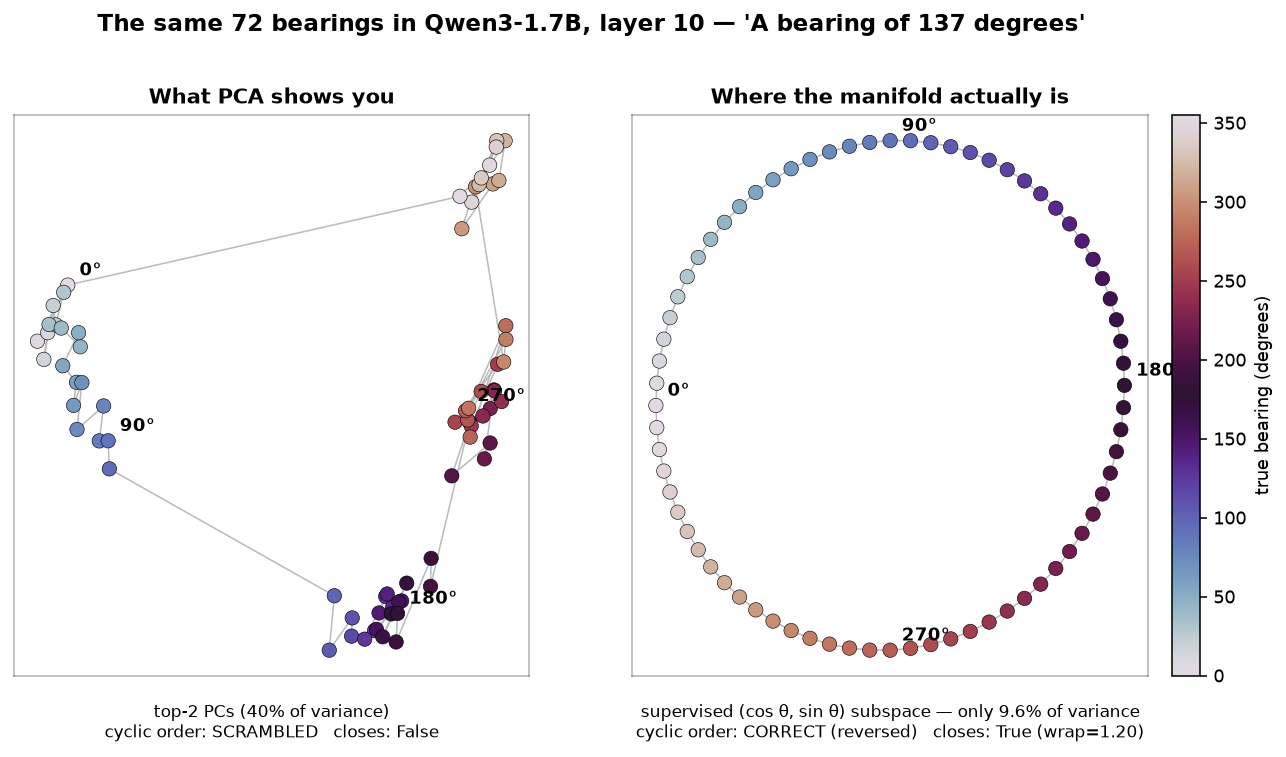
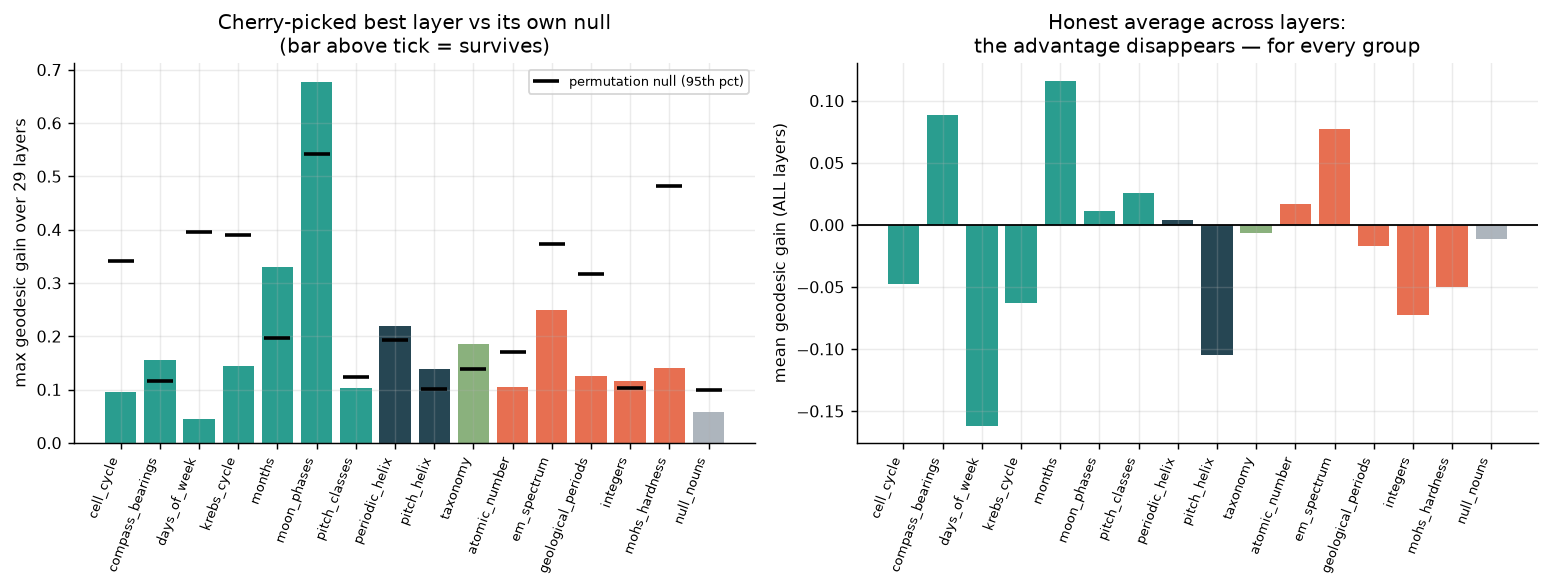
There is a genuine, near-perfect circle for compass directions inside this model. We can read a bearing out of the model's raw numbers to within 4 degrees, on examples it was never shown. Camp B is right that curved structure exists.
The circle is invisible to PCA and UMAP, the standard tools, because it's only 9.6% of the signal and it's buried under the spelling of the words. This is the most useful thing we found. If you go looking for these shapes the normal way, you will conclude they aren't there.
Edit the circle and the model mostly ignores you. Sliding along it steers the model only weakly — while a plain, boring matrix steers it far better and matches the best score theoretically possible. The elegant geometry is real, but it is not where the computation is happening.
We looked hard, with the model-makers' own SAEs, and found no shattering.
No — and that's the neat part. That was an image model, where the thing being tracked (the car's position) is the only thing in its head. There's no spelling to distract it.
A language model reading "137 degrees" always has a loud, easy alternative available:
just read the digits. So it does. The curved shape is there, sitting quietly in the
background, mostly unused.
The shape is real. The shape is hidden. The shape is not the mechanism.
And the thing that would change our mind is finding a concept where the meaning — not the spelling —
is the loudest thing in the model's head.